

How Much Does It Cost To Clean A Lake From Pollution
This is our main data entry on plastics, with a particular focus on its pollution of the environment.
- Nosotros accept also produced an FAQs on Plastics page which attempts to answer additional mutual questions on the topic.
- A slide-deck summary of global plastics is bachelor here.
The first synthetic plastic — Bakelite — was produced in 1907, marking the beginning of the global plastics industry. However, rapid growth in global plastic production was not realized until the 1950s. Over the side by side 65 years, almanac production of plastics increased near 200-fold to 381 one thousand thousand tonnes in 2022. For context, this is roughly equivalent to the mass of two-thirds of the earth population.i
All our charts on Plastic Pollution
How much plastic enters the world's oceans?
To sympathise the magnitude of input of plastics to the natural environment and the world'southward oceans, we must understand diverse elements of the plastic production, distribution and waste matter management chain. This is crucial, not only in understanding the scale of the problem but in implementing the nigh effective interventions for reduction.
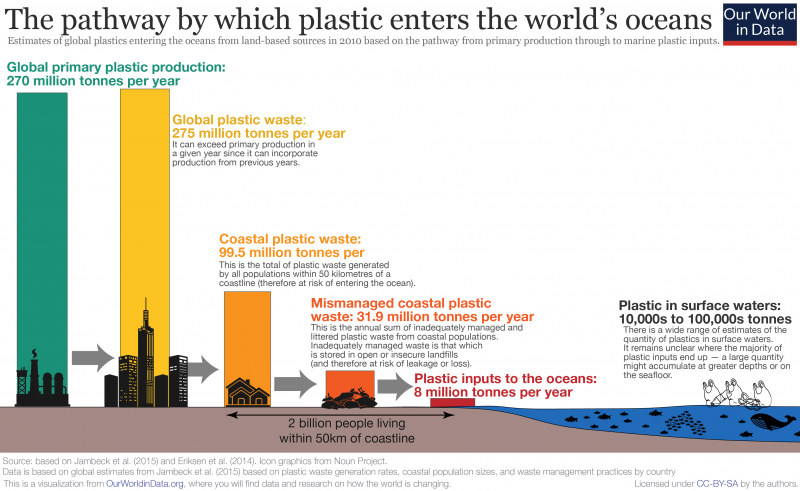
The data and visualizations which follow in this entry provide this overview stride-by-stride. This overview is summarized in the figure.two
Hither we see that in 2022:
- global main product of plastic was 270 million tonnes;
- global plastic waste product was 275 million tonnes – it did exceed annual primary production through wastage of plastic from previous years;
- plastic waste material generated in coastal regions is about at risk of entering the oceans; in 2022 littoral plastic waste material – generated within 50 kilometres of the coastline – amounted to 99.5 million tonnes;
- just plastic waste which is improperly managed (mismanaged) is at significant run a risk of leakage to the environment; in 2022 this amounted to 31.9 million tonnes;
- of this, 8 million tonnes – 3% of global annual plastics waste – entered the body of water (through multiple outlets, including rivers);
- Plastics in the oceans' surface waters is several orders of magnitude lower than annual sea plastic inputs. This discrepancy is known as the 'missing plastic trouble' and is discussed here.
- The amount of plastic in surface waters is non very well known: estimates range from x,000s to 100,000s tonnes.
How much plastic does the world produce?
The chart shows the increase of global plastic production, measured in tonnes per year, from 1950 through to 2022.
In 1950 the world produced but ii million tonnes per yr. Since then, annual production has increased well-nigh 200-fold, reaching 381 one thousand thousand tonnes in 2022. For context, this is roughly equivalent to the mass of two-thirds of the world population.3
The brusk downturn in almanac production in 2009 and 2022 was predominantly the consequence of the 2008 global financial crisis — a like dent is seen across several metrics of resource product and consumption, including energy.
Cumulative production
How much plastic has the world produced cumulatively? The chart shows that by 2022, the globe had produced 7.8 billion tonnes of plastic — more than ane tonne of plastic for every person alive today.
How exercise nosotros dispose of our plastic?
Plastic disposal methods
How has global plastic waste material disposal method changed over time? In the nautical chart we see the share of global plastic waste that is discarded, recycled or incinerated from 1980 through to 2022.
Prior to 1980, recycling and incineration of plastic was negligible; 100 percentage was therefore discarded. From 1980 for incineration, and 1990 for recycling, rates increased on average past almost 0.7 percent per yr.four
In 2022, an estimated 55 percent of global plastic waste was discarded, 25 percent was incinerated, and twenty pct recycled.
If we extrapolate historical trends through to 2050 — every bit can exist seen in the nautical chart here — by 2050, incineration rates would increment to fifty percent; recycling to 44 percent; and discarded waste would autumn to half dozen percent. However, annotation that this is based on the simplistic extrapolation of historic trends and does not represent concrete projections.
Global plastic product to fate
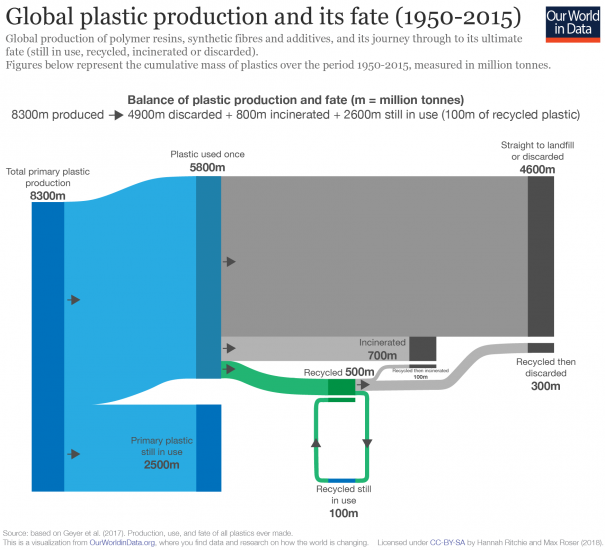
In the figure we summarize global plastic production to last fate over the period 1950 to 2022.5
This is given in cumulative million tonnes.
Equally shown:
- cumulative production of polymers, synthetic fibers and additives was 8300 million tonnes;
- 2500 meg tonnes (30 percent) of chief plastics was still in use in 2022;
- 4600 million tonnes (55 percent) went straight to landfill or was discarded;
- 700 million tonnes (8 percent) was incinerated;
- 500 meg tonnes (6 per centum) was recycled (100 million tonnes of recycled plastic was still in employ; 100 million tonnes was later incinerated; and 300 million tonnes was afterwards discarded or sent to landfill).
Of the 5800 million tonnes of primary plastic no longer in utilize, only ix percent has been recycled since 1950.
Which sectors produce the nearly plastic?
Plastic use by sector
To which industries and product uses is primary plastic production allocated? In the chart we encounter plastic production allocation past sector for 2022.
Packaging was the dominant use of primary plastics, with 42 per centum of plastics inbound the apply phase.vi
Edifice and construction was the second largest sector utilizing 19 pct of the total. Primary plastic production does not directly reverberate plastic waste generation (as shown in the next section), since this is also influenced past the polymer type and lifetime of the end product.
Primary plastic production by polymer type can be found hither.
Plastic waste product by sector
This chart shows the use of primary plastics by sector; in the nautical chart we show these same sectors in terms of plastic waste generation. Plastic waste generation is strongly influenced past primary plastic utilize, merely also the product lifetime.
Packaging, for case, has a very brusk 'in-employ' lifetime (typically around 6 months or less). This is in dissimilarity to building and construction, where plastic use has a mean lifetime of 35 years.7
Packaging is therefore the ascendant generator of plastic waste, responsible for most half of the global total.
In 2022, main plastics product was 407 million tonnes; effectually iii-quarters (302 million tonnes) ended upwardly as waste material.
Plastic waste breakdown past polymer type can be found here.
Plastic waste per person
In the chart nosotros see the per capita charge per unit of plastic waste product generation, measured in kilograms per person per day. Here we come across differences of around an order of magnitude: daily per capita plastic waste beyond the highest countries – Kuwait, Guyana, Federal republic of germany, Netherlands, Ireland, the Us – is more than x times higher than across many countries such as India, Tanzania, Mozambique and Bangladesh.
Notation that these figures represent total plastic waste generation and practise not account for differences in waste matter management, recycling or incineration. They therefore do not stand for quantities of plastic at risk of loss to the ocean or other waterways.
Total plastic waste by land
In the chart we see the total plastic waste generation past state, measured in tonnes per year. This therefore takes business relationship of per capita waste generation and population size. This estimate is available only for the twelvemonth 2022, simply as we come across later in this entry, the relative global picture is similar in projections to 2025.
With the largest population, China produced the largest quantity of plastic, at most 60 million tonnes. This was followed by the Us at 38 one thousand thousand, Germany at 14.5 million and Brazil at 12 1000000 tonnes.
Like the per capita figures higher up, note that these figures represent full plastic waste generation and do not account for differences in waste management, recycling or incineration. They therefore do not represent quantities of plastic at risk of loss to the ocean or other waterways.
Beyond domestic plastic waste generation, there is also a large global commodity market for recycled plastic waste.
Global trade of plastic is discussed here.
Mismanaged plastic waste matter
Mismanaged waste is material which is at loftier risk of entering the ocean via wind or tidal transport, or carried to coastlines from inland waterways. Mismanaged waste product is the sum of cloth which is either littered or inadequately disposed. Inadequately disposed and littered waste are different, and are defined in the sections below.
Inadequately tending waste matter is that which has the intention of being managed through waste collection or storage sites, but is ultimately non formally or sufficiently managed. This includes disposal in dumps or open, uncontrolled landfills; this means the fabric is not fully contained and can be lost to the surrounding environment. This makes information technology at chance of leakage and transport to the natural environment and oceans via waterways, winds and tides.
In the earth map we encounter estimates on the share of plastic waste product that is defined every bit inadequately managed and therefore at run a risk of entering the oceans and other environments. We see very large differences in the effectiveness of waste management across the world:
- High-income countries, including most of Europe, North America, Commonwealth of australia, New Zealand, Japan and South Korea have very effective waste direction infrastructure and systems; this means discarded plastic waste (even that which is non recycled or incinerated) is stored in secure, airtight landfills. Beyond such countries almost no plastic waste is considered inadequately managed. Annotation this does not mean there is no plastic at adventure of entering the natural surroundings — come across the section on littering beneath.
- Beyond many low-to-middle-income income countries, inadequately disposed waste can exist high; across many countries in South asia and Sub-Saharan Africa, between fourscore-ninety per centum of plastic waste is inadequately disposed of, and therefore at risk of polluting rivers and oceans. This is strongly reflected in the global distribution of mismanaged waste and inputs from river systems.
Littered waste is distinct from 'inadequately disposed' waste in that information technology represents plastics that are dumped or disposed of without consent in an inappropriate location.
Whilst loftier-income countries tend to have effective waste management infrastructure and therefore very small quantities of inadequately disposed waste, they can contribute to plastics pollution by littering. Jambeck et al. (2015) assume a rate of littering of 2 per centum of total plastic waste generation beyond all countries.8
A global map of littered plastic from littoral populations (within 50 kilometres of a coastline) is shown hither.
Whilst the global picture of full plastic waste material tells an important story, it does non necessarily help us to sympathize the ocean plastic trouble. To understand the sources of ocean plastic pollution we must take into business relationship multiple factors: proximity of given population centres to the coast, and national waste management strategies. Not all of the plastic waste nosotros generate is at loftier risk of entering the oceans; in fact, for many countries the quantity which does end upwards every bit ocean pollution is very small.
Jambeck et al. (2015) attempted to quantify the amount of plastic that could eventually enter the sea across the world.9
To calculate this, the authors corrected total plastic waste matter generation rates in ii fundamental ways:
(1) they quantified plastic waste generated by coastal populations (those within l kilometres of a coastline) — this represents plastic waste material with the potential to be transported to the coast. Plastic waste generated further inland is unlikely to travel this distance.
(2) they corrected this figure for the quantity of plastic waste that ismismanaged.Mismanaged waste matter is the sum of inadequately managed waste (that which is not formally managed such as disposal in dumps or open up, uncontrolled landfills which could leak to the surrounding environment) and littered waste. Mismanaged waste within coastal populations has potent potential to eventually enter the ocean either through send by wind or tides, or through waterways such as rivers or wastewater.
Subsequently correcting for these factors, the share of global mismanaged plastic waste by land is shown in the chart. This data is bachelor to explore on a per capita basis and on an absolute basis (in tonnes per country). Note that whilst this information is available merely for the yr 2022, projections of global trends for the yr 2025 (discussed in the department beneath) show a very like distribution.
Here we run into a very stiff geographical clustering of mismanaged plastic waste product, a high share of the earth'south ocean plastics pollution has its origin in Asia. China contributes the highest share of mismanaged plastic waste with effectually 28 percent of the global total, followed by 10 per centum in Indonesia, half dozen pct for both the Philippines and Vietnam. Other leading countries include Thailand (3.2 percent); Arab republic of egypt (three pct); Nigeria (ii.7 pct) and South Africa (2 pct). Nosotros talk over why such countries have high mismanaged plastic waste product rates subsequently in this entry.
Whilst many countries across Europe and North America had high rates of per capita plastic generation, once corrected for waste management, their contribution to mismanaged waste at risk of sea pollution is significantly lower.
Mismanaged plastic by region
In the chart we run into the global distribution of mismanaged plastic waste aggregated by globe region. The East Asia and Pacific region dominates global mismanaged plastic waste, accounting for 60 percent of the world total.
There is a wide gap betwixt Eastern asia and the other regions — South asia ranks 2nd just contributes around v times less with xi percent of the full. This is followed by Sub-Saharan Africa (nine per centum); Middle East & North Africa (eight.iii percent); Latin America (7.ii percent); Europe and Central Asia (3.6 pct) and N America (i percent).
If nosotros aim to address the ocean plastic problem, an understanding of this global film is important. It highlights the fundamental role of waste management in preventing body of water pollution; whilst countries across N America and Europe generate significant quantities of plastic waste material (particularly on a per capita basis), well-managed waste product streams mean that very little of this is at risk of body of water pollution. In fact, if North America & Europe were to completely eliminate plastic use, global mismanaged plastic would decline by less than 5 percent.10
Futurity mismanaged plastic
The information presented in the assay higher up is for the year 2022; how is this global motion-picture show likely to change over time? Jambeck et al. (2015) besides projection mismanaged plastic waste production for the year 2025.eleven
These results are presented in the map as the share of global mismanaged waste product by country, and aggregated by region. Absolute figures (in tonnes per year) by country is available to explore hither.
Overall we see that the global distribution is projected to change only slightly; whilst Prc'southward contribution falls by a couple of percentage points, East Asia & Pacific maintain around 60 percent of the total. Due south Asia's contribution — largely driven by India — increases slightly, equally does Sub-Saharan Africa. Latin America, the Centre East & N Africa, Europe and North America all fall in relative terms.12
How much of ocean plastics come from land and marine sources?
Plastic in our oceans tin ascend from both state-based or marine sources. Plastics pollution from marine sources refers to the pollution caused by fishing fleets that leave backside line-fishing nets, lines, ropes, and sometimes abandoned vessels.
There is often intense debate almost the relative importance of marine and land sources for ocean pollution. What is the relative contribution of each?
At the global level, best estimates advise that approximately 80 percent of ocean plastics come up from land-based sources, and the remaining 20 percentage from marine sources.13
Of the 20 percent from marine sources, it'due south estimated that around half (10 percentage points) arises from fishing fleets (such as nets, lines and abandoned vessels). This is supported by figures from the United Nations Surroundings Program (UNEP) which suggests abandoned, lost or discarded fishing gear contributes approximately 10 percent to full ocean plastics.14
Other estimates allocate a slightly college contribution of marine sources, at 28 percentage of total ocean plastics.15
Although uncertain, it's likely that marine sources contribute between 20-30 percent of bounding main plastics, but the dominant source remains land-based input at 70-eighty percent.
Whilst this is the relative contribution every bit an aggregate of global ocean plastics, the relative contribution of different sources volition vary depending on geographical location and context. For example, its estimated that plastic lines, ropes and fishing nets comprise 52 percentage of the plastic mass in the 'Keen Pacific Garbage Patch' (GPGP) (and comprises 46 percent of the megaplastics component of the GPGP).16
The relative contribution of marine sources here is likely to be the result of intensified line-fishing activity in the Pacific Sea.
River inputs to the ocean
There are multiple routes by which plastic tin can enter the ocean environment. I key input is through river systems. This can transport plastic waste matter from further inland to coastal areas where it tin enter the ocean. As nosotros see in the post-obit charts, there is high concentration of plastic within river systems geographically.
Top 20 river sources
In the chart we list the estimated input of plastic to the oceans from the nigh polluting rivers across the earth. This was estimated by Lebreton et al. (2017) for the year 2022.17 They are listed in order with the proper noun of the river, and the countries through which it passes.
The pinnacle xx polluting rivers deemed for two-thirds – 67 percent – of the global annual river input. Geographically we see that the bulk of the most polluting rivers are located in Asia. River Yangtze, the pinnacle polluting river, had an input of approximately 333,000 tonnes in 2022 — over 4 per centum of almanac ocean plastic pollution.
River inputs past region
In the nautical chart we run into river plastic inputs to the bounding main aggregated by region — this is given as a share of the global total.
Near river plastic originates from Asia, which represents 86 pct of the global total. This is followed past Africa at 7.8 per centum, and South America at 4.viii pct.
Collectively, Central & North America, Europe and the Commonwealth of australia-Pacific region account for but over one per centum of the world full.
Which oceans have the virtually plastic waste?
Plastic enters the oceans from coastlines, rivers, tides, and marine sources. Only once it is there, where does information technology become?
The distribution and aggregating of body of water plastics is strongly influenced by oceanic surface currents and air current patterns. Plastics are typically buoyant – meaning they float on the body of water surface –, allowing them to be transported by the prevalent wind and surface current routes. As a result, plastics tend to accumulate in oceanic gyres, with high concentrations of plastics at the heart of sea basins, and much less around the perimeters. Subsequently entry to oceans from coastal regions, plastics tend to migrate towards the centre of ocean basins.
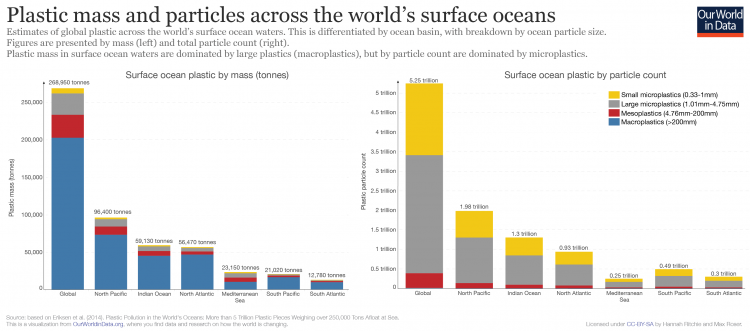
In the nautical chart we see estimates of the mass of plastics in surface body of water waters by ocean basin. Eriksen et al. (2014) estimated that in that location was approximately 269,000 tonnes of plastic in surface waters across the world.18
Annotation that this at least an order of magnitude lower than estimated inputs of plastics to the ocean; the discrepancy here relates to a surprising, but long-continuing question in the research literature on plastics: "where is the missing plastic going?".
Every bit nosotros run into, basins in the Northern Hemisphere had the highest quantity of plastics. This would exist expected since the majority of the world'southward population – and in particular, coastal populations – live within the Northern Hemisphere. However, authors were notwithstanding surprised past the quantity of plastic accumulation in Southern oceans — while it was lower than in the Northern Hemisphere, it was however of the aforementioned society of magnitude. Considering the lack of coastal populations and plastic inputs in the Southern Hemisphere, this was an unexpected effect. The authors advise this means plastic pollution tin can be moved between oceanic gyres and basins much more than readily than previously assumed.
Plastic particles in the world's surface ocean
Information technology'southward estimated that there are more than 5 trillion plastic particles in the world's surface waters.19
We tin see this breakdown of plastic particles by ocean basin here. The aggregating of a big number of particles tends to result from the breakdown of larger plastics — this results in an aggregating of plastic particles for a given mass.
The effigy summarizes plastics in the ocean surface waters by basin. This is shown by particle size in terms of mass (left) and particle count (right). As shown, the majority of plastics by mass are large particles (macroplastics), whereas the majority in terms of particle count are microplastics (small particles).
The 'Great Pacific Garbage Patch' (GPGP)
The about well-known instance of large plastic accumulations in surface waters is the so-called 'Cracking Pacific Garbage Patch' (GPGP). As shown in the nautical chart here, the largest aggregating of plastics inside ocean basins is the North Pacific. This results from the combined impact of large coastal plastic inputs in the region, aslope intensive fishing activity in the Pacific sea.
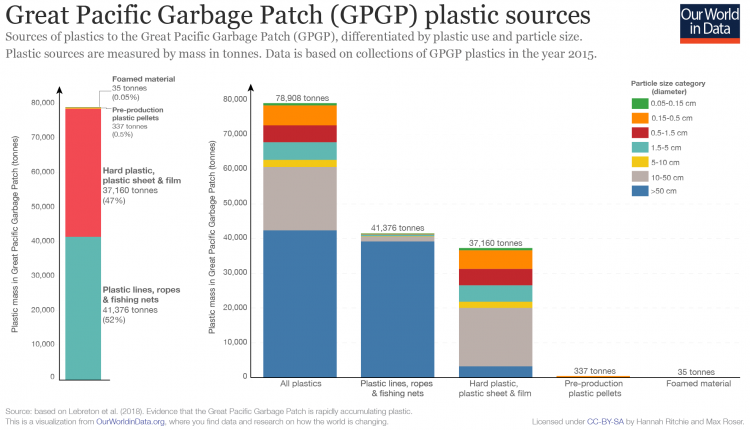
In aNature written report, Lebreton et al. (2018) attempted to quantify the characteristics of the GPGP.20
The vast majority of GPGP fabric is plastics — trawling samples indicate an estimated 99.nine percent of all floating debris. The authors approximate the GPGP spanned 1.6 one thousand thousand kmtwo. This is only over iii times the surface area of Espana, and slightly larger in area to Alaska (the USA'due south largest state).21
The GPGP comprised 1.viii trillion pieces of plastic, with a mass of 79,000 tonnes (approximately 29 percent of the 269,000 tonnes in the world'southward surface oceans). Over recent decades, the authors report in that location has been an exponential increase in concentration of surface plastics in the GPGP.
In the nautical chart we meet the estimated limerick of the GPGP plastic. Effectually 52 percent of plastics originated from fishing activeness and included fishing lines, nets and ropes; a further 47 percentage was sourced from difficult plastics, sheets and films; and the remaining components were pocket-sized in comparing (just under one percent). The dominance of fishing lines, nets, hard plastics and films means that most of the mass in the GPGP had a large particle size (meso- and macroplastics).
Where does our plastic accrue in the ocean and what does that mean for the future?
The world now produces more than 380 million tonnes of plastic every yr, which could end up equally pollutants, entering our natural environs and oceans.
Of grade, not all of our plastic waste product ends up in the ocean, most ends up in landfills: it's estimated that the share of global plastic waste that enters the sea is effectually 3%.22 In 2022 – the year for which we have the latest estimates – that was around 8 1000000 tonnes.23
Most of the plastic materials we produce are less dense than water and should therefore float at the body of water surface. Merely our best estimates of the amount of plastic afloat at bounding main are orders of magnitude lower than the amount of plastic that enters our oceans in a single yr: as we show in the visualization, it's far lower than viii million tonnes and instead in the lodge of 10s to 100s of thousands of tonnes. 1 of the almost widely-quoted estimates is 250,000 tonnes.24
If nosotros currently pollute our oceans with millions of tonnes of plastic each year, we must accept released tens of millions of tonnes in recent decades. Why then do we detect at to the lowest degree 100 times less plastics in our surface waters?
This discrepancy is ofttimes referred to as the 'missing plastic problem'.25 It's a puzzler nosotros need to accost if we want to understand where plastic waste material could finish up, and what its impacts might exist for wildlife, ecosystems and health.
The 'missing plastic trouble'
In that location are several hypotheses to explain the 'missing plastic trouble'.
1 possibility is that it is due to imprecise measurement: we might either grossly overestimate the corporeality of plastic waste we release into the body of water, or underestimate the amount floating in the surface body of water. Whilst nosotros know that tracking ocean plastic inputs and their distribution is notoriously difficult26 the levels of uncertainty in these measurements are much less than the several orders of magnitude that would be needed to explicate the missing plastic trouble.27
Another popular hypothesis is that ultraviolet light (UV) and mechanical moving ridge forces suspension large pieces of plastic into smaller ones.These smaller particles, referred to equally microplastics, are much more easily incorporated into sediments or ingested by organisms. And this is where the missing plastic might end upwards.
One proposed 'sink' for sea plastics was deep-sea sediments; a written report which sampled deep-sea sediments across several basins plant that microplastic was up to four orders of magnitude more than abundant (per unit volume) in deep-ocean sediments from the Atlantic Ocean, Mediterranean Sea and Indian Ocean than in plastic-polluted surface waters.28
But, new research may advise a tertiary caption: that plastics in the sea suspension down slower than previously thought, and that much of the missing plastic is done up or buried in our shorelines.29
Plastics persist for decades and accumulate on our shorelines
To try to understand the puzzler of what happens to plastic waste when it enters the ocean, Lebreton, Egger and Slat (2019) created a global model of ocean plastics from 1950 to 2022. This model uses data on global plastic production, emissions into the sea past plastic type and historic period, and transport and deposition rates to map non only the amount of plastic in different environments in the ocean, simply also its age.
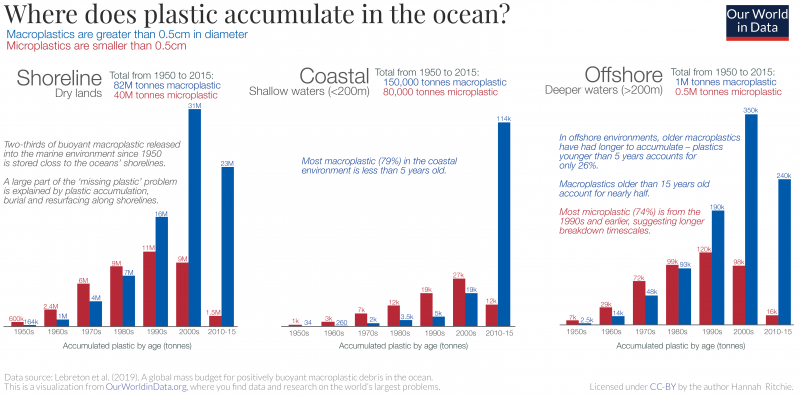
The authors aimed to quantify where plastic accumulates in the ocean beyond three environments: the shoreline (defined every bit dry land bordering the ocean), coastal areas (defined as waters with a depth less than 200 meters) and offshore (waters with a depth greater than 200 meters). They wanted to understand where plastic accumulates, and how erstwhile it is: a few years onetime, ten years or decades?
In the visualization I summarized their results. This is shown for two categories of plastics: shown in blue are 'macroplastics' (larger plastic materials greater than 0.5 centimeters in bore) and shown in crimson microplastics (smaller particles less than 0.5 centimeters).
At that place are some key points we can take abroad from the visualization:
- The vast majority – 82 one thousand thousand tonnes of macroplastics and 40 million tonnes of microplastics – is washed up, buried or resurfaced along the earth's shorelines.
- Much of the macroplastics in our shorelines is from the past 15 years, but still a pregnant amount is older suggesting it can persist for several decades without breaking downwardly.
- In coastal regions about macroplastics (79%) are recent – less than five years old.
- In offshore environments, older microplastics take had longer to accumulate than in littoral regions. There macroplastics from several decades ago – even as far back as the 1950s and 1960s – persist.
- Most microplastics (three-quarters) in offshore environments are from the 1990s and before, suggesting it tin can accept several decades for plastics to break down.
What does this hateful for our agreement of the 'missing plastic' trouble?
Firstly, is that the majority of ocean plastics are washed, cached and resurface along our shorelines. Whilst we try to tally ocean inputs with the amount floating in gyres at the center of our oceans, about of it may exist accumulating around the edges of the oceans. This would explicate why we find much less in surface waters than we'd expect.
Secondly, accumulated plastics are much older than previously idea. Macroplastics announced to persist in the surface of the ocean for decades without breaking down. Offshore nosotros observe large plastic objects dating equally far back as the 1950s and 1960s. This goes against previous hypotheses of the 'missing plastic' problem which suggested that UV low-cal and wave activeness degrade and remove them from the surface in but a few years.
How much plastic will remain in surface oceans in the coming decades?
The study by Lebreton, Egger and Slat challenges the previous hypotheses that plastics in the surface sea have a very brusque lifetime, quickly degrade into microplastics and sink to greater depths. Their results suggest that macroplastics can persist for decades; can be buried and resurfaced forth shorelines; and end upwards in offshore regions years later.
If true, this matters a lot for how much plastic we would expect in our surface oceans in the decades which follow. The same report also modelled how the mass of plastics – both macro and micro – in the globe's surface waters might evolve nether three scenarios:
- nosotros stop emitting any plastics to our oceans by 2022;
- 'emissions' of plastic to the ocean go along to increase until 2022 and then level off;
- 'emissions' proceed to abound to 2050 in line with historic growth rates.30
Their results are shown in the charts.
The scenarios of continued emissions growth are what we'd expect: if nosotros keep to release more plastics to the ocean, we'll take more in our surface waters.
What'south more than hitting is that even if we stopped ocean plastic waste by 2022, macroplastics would persist in our surface waters for many more decades. This is because nosotros have a large legacy of plastics buried and awash on our shorelines which would go along to resurface and be transported to offshore regions; and existing plastics can persist in the ocean environment for many decades.
The amount of microplastics in our surface ocean will increment under every scenario considering the large plastics that we already have on our shorelines and surface waters will proceed to breakdown. And, whatever additional plastics we add will contribute further.
This also matters for how we solve the trouble of ocean pollution.
If we want to chop-chop reduce the amount of both macro- and microplastics in our oceans, these results suggest two priorities:
Number ane — we must stop plastic waste entering our waterways as presently equally possible. Most of the plastic that ends upwardly in our oceans does so because of poor waste management practices – specially in low-to-middle income countries; this ways that good waste management across the earth is essential to achieving this.
But this ambitious target alone volition not be enough. Nosotros accept many decades of legacy waste material to contend with.
This makes a 2nd priority necessary— we have to focus our efforts on recapturing and removing plastics already in our offshore waters and shorelines. This is the goal of Slat, Lebreton and Egger – the authors of this paper – with their Ocean Cleanup project.
How does plastic impact wild animals and homo health?
- What are the impacts of microplastics on wellness?
There accept been many documented incidences of the impact of plastic on ecosystems and wildlife. Peer-reviewed publications of plastic impacts date dorsum to the 1980s.
An analysis past Rochman et al. (2016)31 reviews the findings of peer-reviewed documentation of the impacts of marine plastic debris on brute life; the results of this study are presented in this tabular array.32
Notwithstanding, despite many documented cases, it'south widely acknowledged that the total extent of impacts on ecosystems is not still known.
In that location are three key pathways by which plastic droppings tin affect wildlife33:
Entanglement – the entrapping, encircling or constricting of marine animals by plastic debris.
Entanglement cases have been reported for at least 344 species to appointment, including all marine turtle species, more than two-thirds of seal species, one-tertiary of whale species, and one-quarter of seabirds.34 Entanglement past 89 species of fish and 92 species of invertebrates has also been recorded.
Entanglements almost unremarkably involve plastic rope and netting35 and abased fishing gear.36 However, entanglement by other plastics such as packaging have also been recorded.
Ingestion:
Ingestion of plastic can occur unintentionally, intentionally, or indirectly through the ingestion of prey species containing plastic.
Information technology has been documented for at least 233 marine species, including all marine turtle species, more than one-third of seal species, 59% of whale species, and 59% of seabirds.37 Ingestion by 92 species of fish and 6 species of invertebrates has likewise been recorded.
The size of the ingested textile is ultimately limited by the size of the organism. Very small particles such as plastic fibres tin be taken up by pocket-sized organisms such as filter-feeding oysters or mussels; larger materials such as plastic films, cigarette packets, and food packaging have been plant in large fish species; and in extreme cases, documented cases of sperm whales have shown ingestion of very large materials including 9m of rope, 4.5m of hose, two flowerpots, and large amounts of plastic sheeting.38
Ingestion of plastics tin can have multiple impacts on organism health. Large volumes of plastic can profoundly reduce tummy chapters, leading to poor appetite and false sense of satiation.39 Plastic tin also obstruct or perforate the gut, cause ulcerative lesions, or gastric rupture. This can ultimately lead to death.
In laboratory settings, biochemical responses to plastic ingestion have also been observed. These responses include oxidative stress, metabolic disruption, reduced enzyme activity, and cellular necrosis.40 , 41 , 42 , 43
Interaction – interaction includes collisions, obstructions, abrasions or use as substrate.
There are multiple scenarios where this can accept an touch on organisms.
Fishing gear, for example, has been shown to cause chafe and damage to coral reef ecosystems upon collision. Ecosystem structures tin can also be impacted past plastics following interference of substrate with plastics (impacting on lite penetration, organic matter availability and oxygen exchange).
What are the impacts of microplastics on health?
Impact of microplastics on wildlife
Every bit discussed in the section on 'Impacts on Wildlife' above, there are several ways in which plastics can interact or influence wildlife. In the instance of microplastics (particles smaller than 4.75 millimeter in bore), the key concern is ingestion.
Ingestion of microplastics have been shown to occur for many organisms. This can occur through several mechanisms, ranging from uptake past filter-feeders, swallowing from surrounding water, or consumption of organisms that have previously ingested microplastics.44
There a number of potential effects of microplastics at different biological levels, which range from sub-cellular to ecosystems, but most research has focused on impacts in individual adult organisms.
Microplastic ingestion rarely causes mortality in any organisms. As such, 'lethal concentration' (LC) values which are frequently measured and reported for contaminants do not exist. In that location are a few exceptions: common goby exposure to polyethylene and pyrene; Asian green mussels exposed to polyvinylchloride (PVC); and Daphnia magna neonates exposed to polyethylene45 , 46 , 47
In such studies, however, concentrations and exposure to microplastics far exceeded levels which would be encountered in the natural environment (even a highly contaminated one).
In that location is increasing evidence that microplastic ingestion can affect the consumption of prey, leading to energy depletion, inhibited growth and fertility impacts. When organisms ingest microplastics, it can take upwardly space in the gut and digestive system, leading to reductions in feeding signals. This feeling of fullness tin can reduce dietary intake. Evidence of impacts of reduced food consumption include:
- slower metabolic rate and survival in Asian green mussels48
- reduced reproducibility and survival in copepods49
- reduced growth and development ofDaphnia fifty
- reduced growth and development of langoustine51
- reduced energy stores in shore crabs and lugworms52,53
Many organisms practice non exhibit changes in feeding after microplastic ingestion. A number of organisms, including suspension-feeders (for example, oyster larvae, urchin larvae, European flat oysters, Pacific oysters) and detritivorous (for example, isopods, amphipods) invertebrates prove no impact of microplastics.54 Overall, notwithstanding, it'due south likely that for some organisms, the presence of microplastic particles in the gut (where nutrient should be) can have negative biological impacts.
Affect of microplastics on humans
In that location is, currently, very little evidence of the impact that microplastics can have on humans.
For human health, it is the smallest particles – micro- and nano-particles which are small-scale enough to exist ingested – that are of greatest concern. At that place are several ways past which plastic particles tin can be ingested: orally through water, consumption of marine products which contain microplastics, through the skin via cosmetics (identified equally highly unlikely simply possible), or inhalation of particles in the air.55
It is possible for microplastics to exist passed up to college levels in the nutrient chain. This can occur when a species consumes organisms of a lower level in the food chain which has microplastics in the gut or tissue.56 The presence of microplastics at higher levels of the food chain (in fish) has been documented.57 58
I factor which possibly limits the dietary uptake for humans is that microplastics in fish tend to be present in the gut and digestive tract — parts of the fish not typically eaten.59 The presence of microplastics in fish beyond the alimentary canal (due east.1000. in tissue) remains to be studied in detail.60 Micro- and nanoplastics in bivalves (mussels and oysters) cultured for human consumption accept also been identified. Withal, neither human exposure nor potential risk have been identified or quantified.61
Plastic fibres take also been detected in other food items; for instance, dearest, beer and table common salt.62 , 63 , 64 But the authors suggested negligible health risks as a result of this exposure.
Levels of microplastic ingestion are currently unknown. Even less is known about how such particles interact in the torso. It may exist the example that microplastics just pass directly through the gastrointestinal tract without bear on or interaction.65 A study of N Sea fish, for example, revealed that 80 percent of fish with detected microplastics contained only one particle — this suggests that post-obit ingestion, plastic does not persist for long periods of fourth dimension.66 Concentrations in mussels, in contrast, can be significantly higher.
What could cause concern about the impact of microplastics?
Three possible toxic furnishings of plastic particle take been suggested: the plastic particles themselves, the release of persistent organic pollutant adsorbed to the plastics, and leaching of plastic additives.67
There has been no testify of harmful effects to engagement – however, the precautionary principle would indicate that this is not evidence against taking exposure seriously.
Since microplastics are hydrophobic (insoluble), and are accept a high surface area-to-volume ratio, they can sorb environmental contaminants.68 If at that place was significant accumulation of environmental contaminants, in that location is the possibility that these concentrations could 'biomagnify' up the food chain to higher levels.69 Biomagnification of PCBs varies by organism and environmental conditions; multiple studies have shown no evidence of uptake by the organisms of PCBs despite ingestion70 whilst some mussels, for instance, have shown capability to transfer some compounds into their digestive glands.71
To date, there has been no articulate bear witness of the accumulation of persistent organic pollutants or leached plastic additives in humans. Continued research in this surface area is important to better understand the role of plastic within broader ecosystems and risk to human health.
The impact of Communist china's trade ban
Whilst nosotros looked previously in this entry at the plastic waste generation in countries across the world, it'southward besides important to empathise how plastic waste matter is traded across the globe. Recycled plastic waste material is now a product within the global article market — it is sold and traded across the world.
This has important implications for managing global plastic waste: if countries with effective waste matter management systems – predominantly high-income countries – export plastic waste matter to middle to low-income countries with poor waste material management systems, they could be adding to the ocean plastic problem in this manner.
Plastics can be challenging to recycle, especially if they contain additives and different plastic blends.
The implications of this complexity are two-fold: in many cases it is convenient for countries to export their recycled plastic waste matter (meaning they don't have to handle information technology domestically); and for importing countries, this plastic is often discarded if information technology doesn't meet the sufficient requirements for recycled or is contaminated by not-recyclable plastic. As such, traded plastic waste could eventually enter the ocean through poor waste management systems.
Collectively, China and Hong Kong have imported 72.4 percent of global traded plastic waste matter (with nigh imports to Hong Kong eventually reaching Cathay).72
This came to an terminate in 2022. At the finish of that twelvemonth China introduced a complete ban on the imports of non-industrial plastic waste matter.73
How much plastic waste did Cathay import?
In the chart we see the quantity of plastic waste product Cathay had to manage over the flow from 2022 to 2022. This is differentiated by domestic plastic waste material generation, shown in grey, and imported plastic waste shown in cherry-red. The total plastic waste to manage is equal to the sum of domestic and imported plastic waste.
Over this period, China imported between vii and 9 million tonnes of plastic waste material per year. In 2022, this figure was 7.35 meg tonnes. To put this in context, China'southward domestic plastic waste generation was around 61 million tonnes. Therefore, 10-xi percentage of China's total plastic waste matter was imported from around the world.
Who were the main plastic exporters to Prc?
Which countries consign the most plastic waste product to China? In the nautical chart nosotros see the quantity of plastic exported to China from the top x exporting countries. Collectively, these countries are responsible for around 76 pct of its imports.
As we see, Hong Kong typically acts as an entry point for Chinese imports; information technology is therefore the largest 'exporting' state to China. Many high-income countries are included in this pinnacle ten: Nippon, USA, Germany, Belgium, Australia and Canada are all major plastic exporters.
How much plastic will be displaced from the Chinese import ban?
China has been increasing restrictions on its plastic waste imports since 2007. In 2022, information technology implemented its "Dark-green Fence" plan – a temporary restriction for plastic imports with significantly less contamination.
In 2022 it implemented a much stricter, permanent ban on non-industrial plastic imports.74 In the chart we come across the estimated impact on the cumulative deportation of global plastic waste material to 2030 as a outcome of the Chinese import ban.75 This is shown for iii scenarios: assuming the maintained 100 percent import ban, in addition to the touch if this was reduced to 75 or 50 percent.
By 2030, information technology's estimated that around 110 1000000 tonnes of plastic will be displaced equally a result of the ban. This plastic waste product will accept to be handled domestically or exported to another country. Brooks et al. (2018) suggest this ban has several implications:
- exporting countries can employ this equally an opportunity to ameliorate domestic recycled infrastructure and generate internal markets;
- if recycling infrastructure is defective, this provides further incentive for countries to reduce master plastic production (and create more circular material models) to reduce the quantity of waste product which needs to be handled;
- it fundamentally changes the nature of global plastic trade, representing an opportunity to share and promote all-time practices of waste matter direction, and harmonize technical standards on waste protocols;
- some other countries may effort to become a central plastic importer in place of China; i claiming is that many countries practise non yet have sufficient waste direction infrastructure to handle recycled waste material imports;
- countries considering importing pregnant quantities of plastic waste could consider an import tax specifically aimed at funding the evolution of sufficient infrastructure to handle such waste material.
What determines how much plastic waste material we produce?
In the chart nosotros show the plastic waste generate charge per unit per person versus gross domestic production (GDP) per capita. In general — although there is significant variation beyond countries at all levels of development — plastic waste generation tends to increase as nosotros get richer. Per capita plastic waste product at depression incomes tends to be notably smaller.
What determines how much mismanaged waste we produce?
Whilst per capita plastic waste generation tends to increase with income (run across to a higher place), this general relationship does not hold when nosotros consider mismanaged plastic waste.
In the chart we show themismanaged per capita plastic waste generation rate versus Gross domestic product per capita.
Here we meet an inverse-U curve pattern. Mismanaged waste generation tends to be low at very depression incomes (since per capita waste is small); information technology then rises towards middle incomes; and then falls over again at college incomes.
Countries around the heart of the global income spectrum therefore tend to take the highest per capita mismanaged plastic rates.
This has typically occurred in countries that take rapidly industrialized, but failed to make progress in waste management at the same speed.
The development of effective waste management infrastructure, particularly in middle-income countries, is therefore crucial to make progress confronting plastic pollution.
Countries with large coastal populations also have larger amounts mismanaged plastics
It is also the case that countries with high levels of mismanaged waste also have big coastal populations (as shown in the nautical chart). This exacerbates the challenge of bounding main plastic pollution considering poorly-managed waste is at loftier risk of entering the ocean.
Boosted FAQs on Plastics
In addition to this chief data entry nosotros accept collated some of the nearly common questions on plastics on our FAQ on Plastics page. Yous may find the answer to additional questions on this topic there.
Data Quality & Definitions
- Data Definitions
- Plastic particles size categories
Data Definitions
The definitions of key terms used in this entry are as follows:
Discarded: waste product that is not recycled or incinerated; this includes waste that goes to landfill (closed or open), is littered, or lost to the natural environment.
Incineration: a method waste treatment which involves the called-for of cloth at very high temperatures. In some cases, energy recovery from the incineration process is possible. The called-for of plastics can release toxins to the air and surrounding environment and should therefore be carried out under controlled and regulated weather condition.
Inadequately managed waste:waste matter is not formally managed and includes disposal in dumps or open, uncontrolled landfills, where it is not fully contained. Inadequately managed waste matter has loftier hazard of polluting rivers and oceans. This does not include 'littered' plastic waste, which is approximately ii% of total waste (including high-income countries).76
Mismanaged waste: material that is either littered or inadequately disposed (the sum of littered and inadequately disposed waste). Inadequately disposed waste matter is not formally managed and includes disposal in dumps or open, uncontrolled landfills, where it is not fully independent. Mismanaged waste product could eventually enter the ocean via inland waterways, wastewater outflows, and transport past wind or tides.77
Plastic particles size categories
Plastic particles are typically grouped into categories depending on their size (as measured by their diameter). The table summarizes some standard ranges for a given particle category.78
| Particle category | Bore range (mm = millimetres) |
| Nanoplastics | < 0.0001 mm (0.1μm) |
| Small microplastics | 0.00001 – i mm |
| Large microplastics | 1 – 4.75 mm |
| Mesoplastics | four.76 – 200 mm |
| Macroplastics | >200 mm |
Data Sources
Jambeck et al. (2015). Plastic waste matter inputs from country into the ocean.
- Information: Plastic waste generation rate, mismanaged waste and plastics entering the ocean
- Geographical coverage: Global by country
- Fourth dimension span: Estimates for 2022 and projections for 2025
- Bachelor at:http://science.sciencemag.org/content/347/6223/768
Geyer, R., Jambeck, J. R., & Law, K. L. (2017). Production, apply, and fate of all plastics e'er fabricated.
- Data: Plastic product, by sector and polymer type; and fate of plastics
- Geographical coverage: Global
- Time bridge: 1950-2015
- Available at:http://advances.sciencemag.org/content/3/7/e1700782
Eriksen et al. (2014). Plastic pollution in the globe'due south oceans: more v trillion plastic pieces weighing over 250,000 tons afloat at sea.
- Information: Estimates of plastics floating in surface oceans
- Geographical coverage: Global, by ocean
- Fourth dimension bridge: 2013
- Available at:http://journals.plos.org/plosone/article?id=ten.1371/journal.pone.0111913
Lebreton et al. (2018). Prove that the Smashing Pacific Garbage Patch is rapidly accumulating plastic.
- Data: Estimates of plastic accumulative in the Nifty Pacific Garbage Patch
- Geographical coverage: Pacific Bounding main
- Available at:https://www.nature.com/articles/s41598-018-22939-w

Source: https://ourworldindata.org/plastic-pollution
Posted by: harringtonwough1973.blogspot.com
0 Response to "How Much Does It Cost To Clean A Lake From Pollution"
Post a Comment