

How To Make Windows More Energy Efficient
Windows and doors can account for up to 25 percent of total firm rut loss. Windows and doors tin can exist repaired, even so at times information technology is all-time to replace them with more than energy-efficient models. Proper installation and maintenance likewise play a key role in saving energy and improving comfort. Learn about upgrading or replacing windows and doors.
Chapter Summary
- 8.1 WINDOWS
- 8.2 DOORS
8.1 WINDOWS
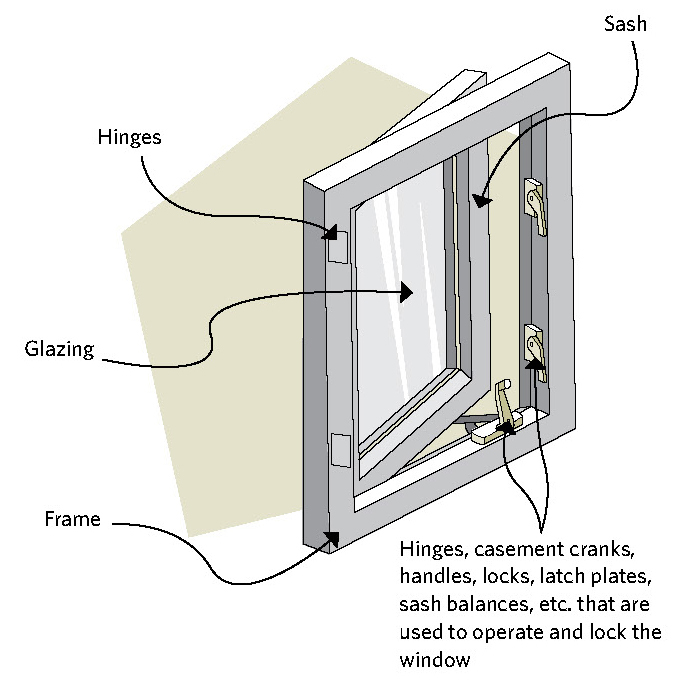
Figure 8-1 Casement window showing parts and hardware
Larger prototype
Text version
Figure viii-1 Casement window showing parts and hardware
- Hinges
- Glazing
- Frame
- Sash
Hinges, casement cranks, handles, locks, latch plates, sash balances, etc. that are used to operate and lock the window
There are a number of options for upgrading the free energy efficiency of your windows. Windows can be repaired past servicing hardware such every bit latches, cranks and locks or retrofitted with caulking and weatherstripping or adding glazing and tempest windows. At times the all-time choice is total window and frame replacement with new, high-operation Free energy STAR® certified windows or inserts. If the frames are yet in good status, inserts (i.e. new sash and glazing units) tin can exist a good choice, especially for homes with heritage condition.
8.ane.1 Replacing glazing, sashes and windows
Properly installed energy-efficient windows make homes more than comfortable by reducing drafts and increasing the temperature of the interior side of the window, reducing condensation. Energy-efficient windows will take many of the following features:
- double-, triple- or even quadruple-glazing
- low-emissivity (low-E) drinking glass
- inert gas, such argon or krypton in the sealed unit
- low conductivity or warm-border spacer bars
- insulated frames and sashes
- good air tightness
If your inspection has revealed serious problems with a window's glazing, sash or the entire unit, your all-time pick will be to replace all or function of the window.
For case, if the glazing is only a single pane of drinking glass or is in poor status, you tin buy a new sealed glazing window insert. If the frame is in poor condition, it may be time to replace the unit.
8.1.two Taking stock
Check each window for signs of impairment: rot, mould and/or staining on or effectually the window, the condition of the glass, putty and pigment, weatherstripping and the operation and condition of the hardware. Some windows may need only minor air sealing piece of work, while others require major upgrading or even replacement. Cheque for air leakage around the frame and at all movable joints. Combine a visual inspection with a test using a leak detector equally described in Department 2, "How your house works."
8.i.3 Condensation problems
Interior surface condensation and frosting are common complaints. Sometimes the problem is light fogging on some windows; at other times, in that location may be persistent and heavy frost roofing the drinking glass. Many homeowners buy new windows only to find that the problem becomes worse considering the erstwhile, leaky windows actually helped to reduce humidity. The new windows seal the house more tightly, causing a ascent in humidity. 1 solution is to reduce humidity levels in the house.
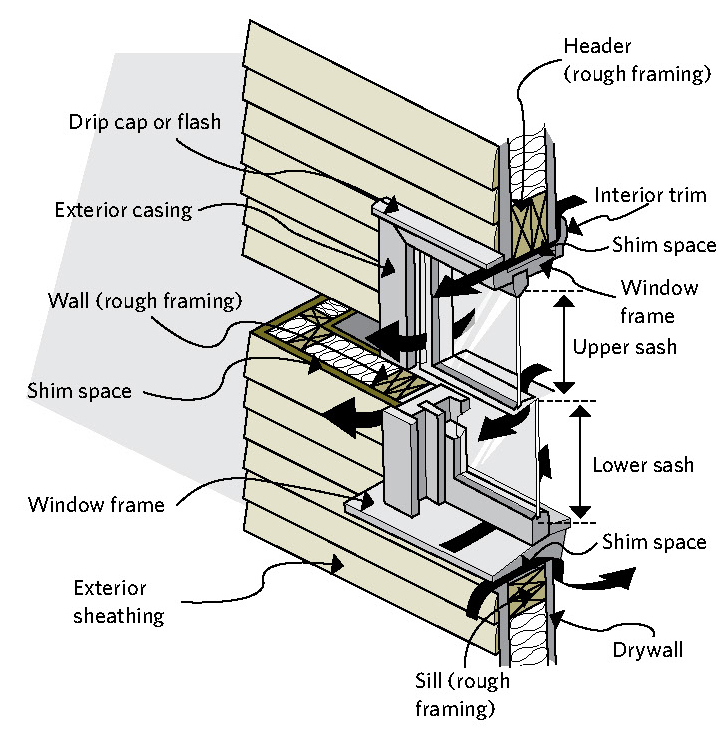
Figure eight-two Double-hung window showing parts and air-leakage paths
Larger image
Text version
Figure 8-2 Double-hung window showing parts and air-leakage paths
- Drip cap or flash
- Exterior casing
- Wall (rough framing)
- Shim infinite
- Window frame
- Exterior sheathing
- Header (rough framing)
- Interior trim
- Shim infinite
- Window frame
- Upper sash
- Lower sash
- Shim space
- Drywall
- Sill (rough framing)
For more data on moisture and condensation, run into Section 2, "How your firm works," and Section iv, "Comprehensive air leakage control."
Alternatively, y'all tin can increase the surface temperature of the window and frame by calculation another layer of glazing. New energy-efficient windows are the best solution.
When condensation forms between panes on non-sealed glazing units or storm windows, moist house air has leaked past the inner pane and condensed on the outer pane. Even dry houses can suffer from this type of condensation problem. This problem is mutual on second storeys where at that place is more than air being pushed out the window because of the stack effect. The solution is to weatherstrip the inner sash to forestall air leakage; make sure that the weep holes on the storm windows, which allow water to escape, are open to the outside.
If condensation occurs inside a sealed double-glazed unit, the trouble is all-time corrected by replacing the glazing unit. Although some specialty companies can refurbish sealed glazing units that have failed, this is considered a temporary fix that will not offer the same original energy efficiency. Check to see if the window is still under warranty.
8.ane.4 Interior caulking
Window air leakage tin can be reduced by applying a continuous bead of caulk around the window trim where it meets the wall, at the mitred joints of the trim, and between the trim and the frame (come across Effigy 8-3). Make certain the caulk is intended for indoor use (do non utilize exterior caulking indoors), tin be painted and is of good quality. For more than information about caulking products, see Part 3.three, Air barrier materials.
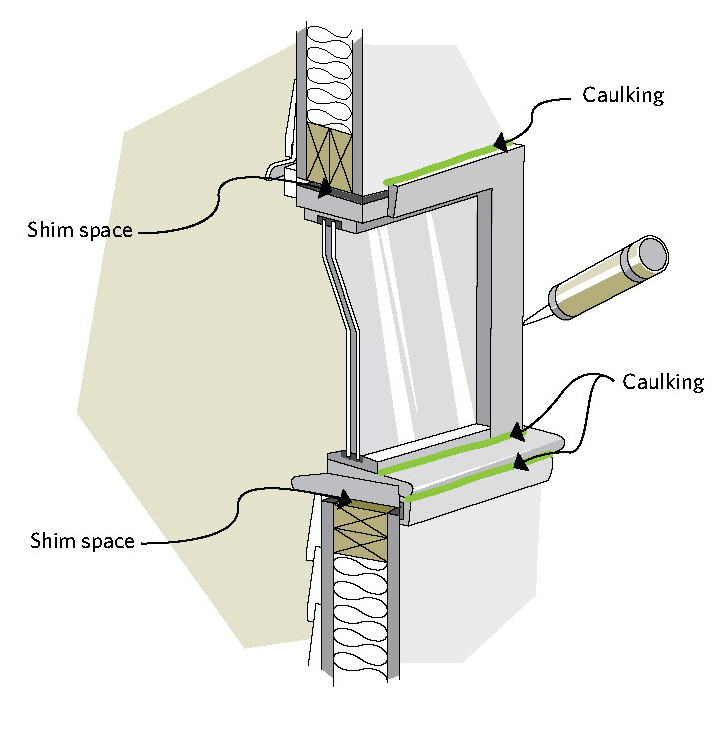
Figure 8-3 Where to caulk the joints of a fixed window
Larger paradigm
If a window is specially leaky and the trim can be easily removed and re-installed, remove the trim, add insulation and seal the gap before reapplying the trim. If the gap is small, half dozen mm (¼ in.) or less, insulating the gap followed past caulking may suffice. Larger gaps may require either a backer rod with caulking or low-expansion foam (see Figure 8-four).
To further reduce air leakage, utilize a layer of red technical tape to cover the joint between the wall and window frame. Ensure that the tape will be hidden by the trim every bit it cannot be painted and red agglutinative may remain later excess tape is removed.
viii.1.5 Exterior caulking
Exterior caulking is the last and weakest defence against rain entering a wall from the exterior. The best defence against window and door wall leakage includes the following ii items:
- properly applied flashing (i.e. peak window flashing is underneath the air bulwark, while side and bottom flashings are on top of the air barrier)
- a properly detailed drainage airplane
Caulking on the outside of a window should be done only after interior sealing is complete. If the exterior is caulked start, information technology can trap warm, moist air in the wall, which over time, can damage the wall.
eight.1.6 Weatherstripping
Weatherstrip windows around the sash to reduce air leakage. If the windows practise not have to exist opened and do not serve equally emergency exits, they can be locked and caulked. Where storm windows are installed, seal the inside window more than tightly than the outside window to reduce condensation bug.
TECHNICAL Notation
Building codes require that every bedroom have at least one window that opens from the inside to allow escape in case of emergency. Be mindful of this requirement before deciding to seal shut certain windows."
Many types of weatherstripping are bachelor. Table 3-4 lists some of the more common varieties of weatherstripping, though it is certainly non an exhaustive list. Try to visit a window and door supplier that stocks a wide variety of original manufacturer products. For newer windows with built-in weatherstripping that has lost its effectiveness over time, pry out a sample and accept information technology to the window manufacturer or supplier for replacement with the same type. Cheaper products are commonly less durable and less effective, so practice not choose but on the ground of cost.
Preparation and installation are important and typically involve the post-obit steps:
- Endeavor to accommodate and square windows that are out of alignment.
- Remove old weatherstripping, caulking and blobs of paint from contact surfaces. If the surface is very uneven, employ a dewdrop of caulking under the weatherstripping or fill, sand and paint the surface to make it smooth.
- Clean the surface with a make clean textile and fast-drying mineral spirits or MEK (methyl ethyl ketone).
- Apply the weatherstripping. With doors and windows that are used oft, you may want to reinforce the adhesive types with staples.
- Check the window for smooth performance and ensure all hinges, slides and hardware operate freely and correctly.
- Periodically cheque the weatherstripping for vesture.
i) Double-hung and single-hung windows
Double-hung and unmarried-hung windows should be weatherstripped on the sides, top and bottom of the moving sash, as shown in Figure viii-5. Caulk air leaks effectually the fixed portion of the window.
Sides
The thin plastic V-blazon weatherstripping is a good choice. Open the window and slip the stripping upwards the crack between the sash and the frame, with the oral fissure of the Five facing the outside. Information technology demand only extend to 25 mm (ane in.) above the top of the closed window. You can do a better job if you showtime remove the stop and the bottom sash.
Top
Weatherstrip the space where the 2 sashes encounter by removing the lower sash and applying 5-type weatherstripping to the upper window from the within.
Bottom
Apply V-type or compression-type neoprene rubber to the windowsill where the closed window will sit or to the bottom of the moving window sash itself.
two) Sliding windows
Sliding windows with sashes typically use brush weatherstripping that will require removing the sash and pulling the old weatherstripping out of its slot. Cutting the new material to the length required and snap or slide it into the slot. Tack, staple or glue each end of the brush cloth to ensure that the weatherstripping stays in place earlier reinstalling the sash.
Sashless sliders – panes of drinking glass not encased in a frame – are inefficient. At the very least they should be supplemented with interior tempest windows. Better nevertheless, supplant them with energy-efficient units.
iii) Swing-type (hinged) windows
Swing-blazon (hinged) windows are treated like doors. Apply weatherstripping to the frame and so information technology meets the edge of the sash or place it on the stop where it will run into the face of the sash. The forcefulness of a closed window against the weatherstripping makes a force per unit area seal. Hinged windows usually require a combination of V-strip and pinch-type weatherstripping. Hinges and locking hardware may complicate the job. Sometimes, more than i weatherstrip will therefore exist needed in those areas.
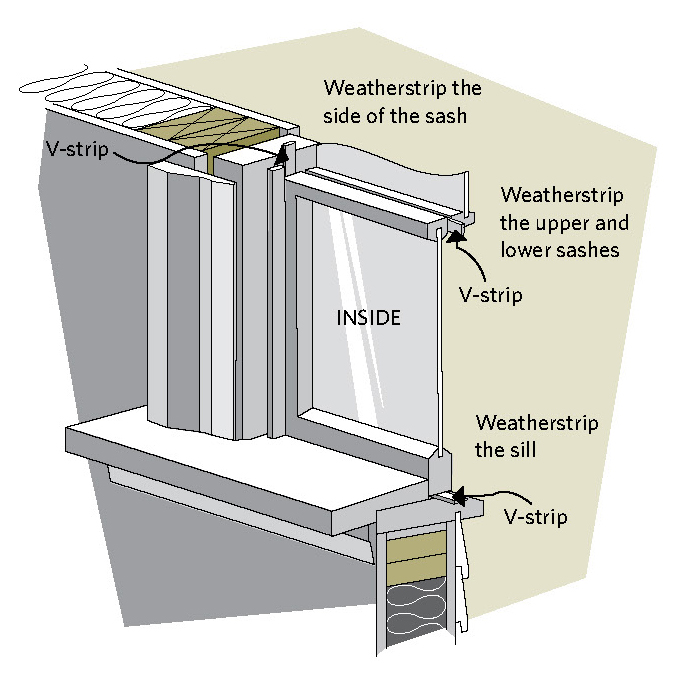
Effigy 8-5 Where to weatherstrip a single hung window
Larger prototype
viii.1.7 Tempest window systems
Single-glazed windows lose about ten to xx times as much rut as the same area of a properly insulated wall. Storm windows or double-glazed sealed units will reduce the heat loss by near half.
Storm windows can be installed on the within or the exterior, can exist permanent or seasonal, and can be made to social club.
Outside storm window systems
Outside storm windows were once very common and proceed to serve a useful part in many applications. They are usually constructed of a wood or metal frame, with glass or an acrylic canvass as glazing.
Exterior tempest windows tin can be either seasonal (installed in the fall and removed in the spring) or permanent. Seasonal storm windows should be inspected each twelvemonth earlier installation to ensure that the glazing, putty and weatherstripping are in good condition. A drawback of seasonal units is the labour involved in installing and removing them each twelvemonth, besides as the need for storage. Permanent exterior storm windows are commonly equipped with a congenital-in screen and a sliding sash.
When you utilise outside storm windows, the main interior window must be air sealed more tightly than the storm window to prevent moist household air from entering the space between the windows and being trapped, where it can condense and cause deterioration of the sash and frame.
Interior storm window systems
Interior storm windows are generally attached directly to the window frame, which helps reduce air leakage effectually the window. To minimize condensation and air leakage, interior storm windows should be sealed tightly and so that no warm air gets between the storm unit and the original window after installation.
Interior storm windows are lighter and more accessible than seasonal exterior storm windows especially on upper floors. A disadvantage is that blinds or other window treatments may have to be repositioned to accommodate the tempest window.
Interior storm windows are typically used in the winter but and are stored for the rest of the year. However, in an air-conditioned firm, they tin can also help go on heat out and cool air in during the hot summer months.
In that location are ii mutual interior storm window organization options – rut-compress film with double-sided tape and clear rigid acrylic sheets with magnetic seals.
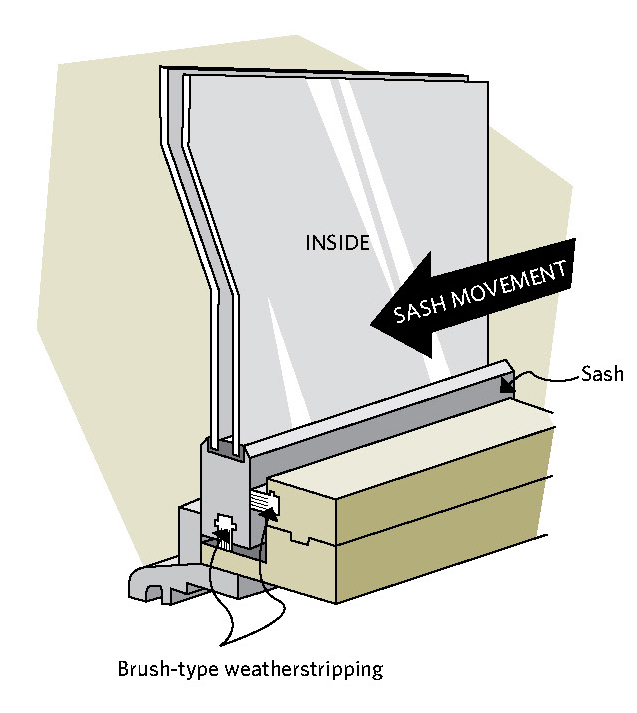
Figure 8-vi Brush weatherstripping on a sliding window
Larger image
i) Heat-shrink film with double-sided tape
These cheap, temporary, do-it-yourself kits are sold at virtually hardware and building supply stores and include instructions for installation. With this system, ii-sided tape attaches the movie to the window trim, after which the film is heated with a hair dryer to shrink it tightly across the window. In most cases, the film tin can be used only once.
Although this organisation provides an excellent seal and skillful visibility, the ii-sided record can elevator paint when it is removed. Too, once this system is installed, the window cannot exist opened without removing or puncturing the film.
Points to go on in mind:
- Lightweight movie may exist damaged if you lot have young children or pets in the firm.
- Plastics must be kept away from strong heat sources.
- Some people may exist sensitive to plastics, which can emit odours, peculiarly when their surfaces are warmed by sunlight.
ii) Clear rigid acrylic sheets with magnetic seals
This seasonal organisation is more durable than plastic moving picture but more than expensive; plus, information technology may require the services of a contractor. To install a magnetic seal system, a metallic strip is fastened to the window trim using double-sided tape (this strip can exist painted to match the frame). A magnetic moulding is then secured to the acrylic sheet and the sheet is pressed into place on the metal strip.
When the acrylic sheets are not in use, they must be stored in a flat or vertical position (non slanted) and in a cool place protected from exposure to sunlight and excessive estrus. The rigid glazing is easier to clean and has a more finished appearance than shrink film.
Some plastic supply stores sell these systems (and the appropriate cleaning products) and can cut the sheets to the size required. Besides, some firms specialize in manufacturing and installing these systems.
Specialty products
There are two products that are near suitable for areas that take very high solar gains that brand the room besides hot: applied window films and multi-layered polyester films. Films are usually professionally applied with some precautions.
Applied window films are commonly made from a clear or tinted polyester substrate with a scratch-resistant coating on ane side and an adhesive with a protective liner on the other. Multi-layered polyester films are black on one side and silvery on the other. The film is permanently attached to the window past removing the liner and pressing it firmly on the glass.
Window films with a solar-control coating reduce solar gain and help protect carpet, draperies, piece of furniture and wood from fading. They should not be used on all windows every bit they offer very little increased insulation and greatly cutting down on solar gain, which could lead to higher energy bills during the heating flavour. There is likewise a small risk of glass breakage due to increased thermal stress and the utilise of these films may void the warranty issued by the original window manufacturer.
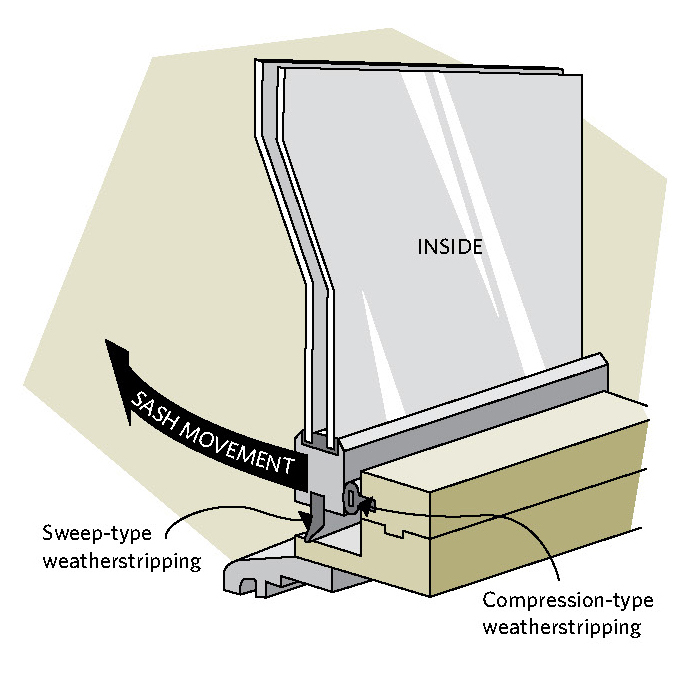
Figure viii-7 Pinch and sweep weatherstipping on a casement window
Larger prototype
Curtains and blinds can assist reduce radiant heat loss from windows during the heating flavour and reduce solar gain during the summertime. Shutters, shades, awnings and copse can likewise reduce solar gains during the summer. Close window coverings during the day and open up windows at nighttime for ventilation.
During the heating season, insulated drapes offer somewhat more than benefit than not-insulated drapes and blinds. However, as curtains and blinds are not airtight, they may cause window condensation bug in the winter.
8.1.8 Skylights
Skylights commonly endure from water leakage and condensation around the frame and curb or tunnel. For operable skylights, ensure that hardware is working and all seals are in good social club. Continue pelting out by repairing exterior seals and flashings. Curbs and interior tunnels around the skylight must be well insulated and air sealed to reduce condensation. Reduce summer overheating with low-cal-reflective glazing and blinds.
Practise not open a skylight (or upper storey window) in hot weather if the house air temperature is cooler than the outside air. Opening the skylight draws hot air into the house, negating the effectiveness of air conditioning or natural cooling.
8.1.9 Information on ownership new windows and doors
Helpful publications publications on energy-efficient windows and doors can be plant at our Publications website.
viii.2 DOORS
Poor installation, years of difficult employ, shifting foundations and seasonal warping can oft force hinged doors and sliding glass patio doors to become out of foursquare with their frames. If doors practise not fit snugly, gear up or supersede the door, frame, hardware, gaskets and weatherstripping. The same techniques for preparing windows (equally explained in Office 8.1, Windows) apply to all doors including whatever needed repairs or adjustments, surface training and cleaning for the weatherstripping.
Weatherstrip the pinnacle and sides of the door frame every bit illustrated in Figure 8-eight, Office A and Figure 8-viii, Role B. The easiest and near effective weatherstripping for a door frame is a skillful quality V-shaped vinyl blazon. It makes contact with the edge of the door and provides a good seal even when the door warps from season to season.
For increased protection, attach weatherstripping to the stop then that it presses against the face of the door as shown in Figure viii-8, Part A.
There are also many types of combination metal and foam or rubber weatherstripping that are screwed to the finish. They should be adjusted regularly to conform to the changing warp of the door.
Employ weatherstripping to either the door sill (see the threshold in Figure viii-8, Part C) or to the door itself. Although this tin can be a difficult area to seal well, it is worthwhile doing because this is ofttimes a source of major drafts. Use durable textile that tin withstand traffic and is flexible enough to accommodate to changes in the door caused by fluctuations in humidity and temperature. The weatherstripping should also exist easy to replace. A expert seal can ordinarily exist obtained with gasketed door-bottom weatherstripping that attaches to the door, or with total or partial threshold weatherstripping that is attached to the door sill.
When the weatherstripping is practical to the door itself, a very durable material is necessary. The most effective selection is the combination type, which is but tacked or screwed along the lesser within surface of the door. There should be slots that allow for some adjustment of the weatherstripping.
There is a wide diversity of door weatherstripping on the marketplace, including kits that include weatherstripping and threshold or door lesser seals. Some products come up with replacement seals. Wait for loftier-quality, durable products.
For sliding patio doors, replace weatherstripping and hardware when worn. Replace poor condition sliding patio doors with Energy STAR® certified units or with French or garden-style doors and additional energy-efficient windows. In the acting, older patio sliding doors non used in winter can exist sealed with removable sealant or covered with heat-shrink film.
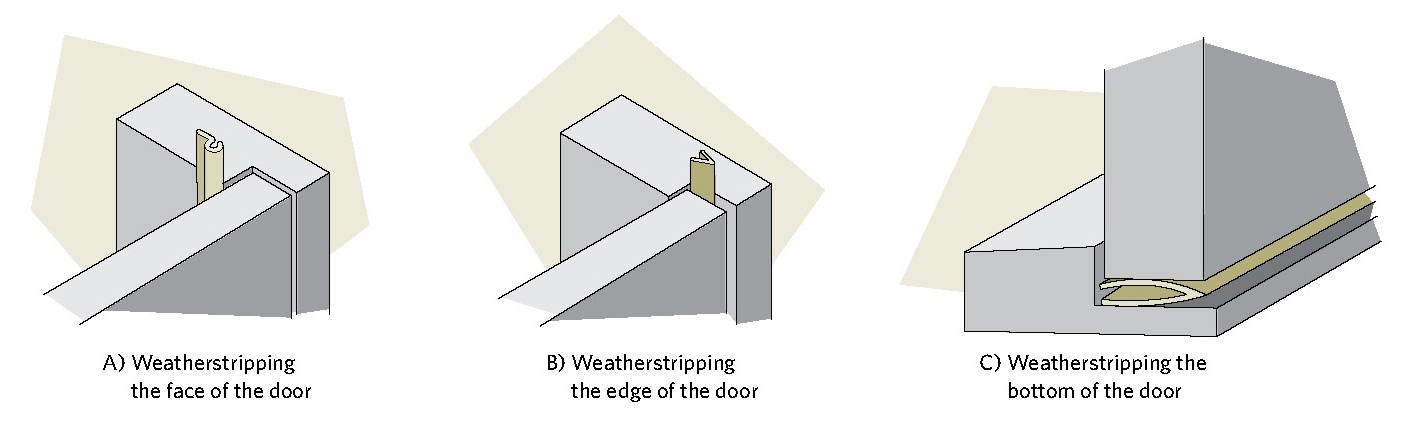
Effigy 8-8 Methods of weatherstripping a door
Larger prototype
Text version
Figure 8-8 Methods of weatherstripping a door
A) Weatherstripping the confront of the door
B) Weatherstripping the edge of the door
C) Weatherstripping the lesser of the door
viii.two.1 Contracting the work
Air sealing and repairing windows and doors can go part of the work of an air sealing contractor (encounter Section three, "Materials"). If you are having only some of the windows or doors replaced, ask the contractor to check and replace defective weatherstripping on the remaining units.
8.2.ii Window and door contractors
When getting estimates, make certain the contractor has feel in the type of work you desire done. Enquire the contractor if the visitor offers a third-party warranty on products and services.
Back: Section 7: Insulating walls Side by side: Section 9: Operating your house
Source: https://www.nrcan.gc.ca/energy-efficiency/homes/make-your-home-more-energy-efficient/keeping-the-heat/section-8-upgrading-windows-and-exterior-doors/15643
Posted by: harringtonwough1973.blogspot.com
0 Response to "How To Make Windows More Energy Efficient"
Post a Comment